Gell-Mann's War Fever
- Martin Enlund
- 3/22/26
The pattern of false dichotomies repeated itself when Sweden’s former Prime Minister Carl Bildt claimed that the attacks against Iran constitute “a clear violation of international law”.
The reactions were overwhelmingly negative. “Whose side is Bildt really on, the people’s or the oppressors’?” some wondered. Someone even asked if Bildt shouldn’t be “forcibly medicated”.
Author Michael Crichton warned of an interesting phenomenon in a speech from 2002. He described how we can read a newspaper article within our area of expertise, realize that the author is completely wrong, yet still trust the newspaper’s reporting on all other issues. He named the phenomenon “Gell-Mann Amnesia” - a type of memory loss.
The background to the American attack on Iran is debated. According to US Secretary of State Marco Rubio, the goal was to prevent Iranian retaliation against the US following an imminent Israeli operation. President Trump has instead said that he wants to see a regime change.
According to research, the US has attempted to carry out regime changes at least 80 times since the end of World War II, primarily covertly. The majority of these attempts have failed. When they have succeeded, they have not only tended to promote authoritarian leaders, but the intervention has also coincided with an increased risk of civil war in the affected countries. In two out of five cases, civil war breaks out within ten years.
US regime change campaigns have, especially since George W. Bush’s ultimatum in 2001 that “either you are with us, or you are with the terrorists”, followed a destructive template. When the US attacked Afghanistan under the pretext of carrying out a regime change, the result was a 20-year conflict where hundreds of thousands died, drug production skyrocketed, and astronomical sums vanished into the sand. After the invasion of Iraq in 2003, where the attack was based on fabricated weapons of mass destruction and with the goal of removing Saddam Hussein, the result was hundreds of thousands dead, an uprising that allowed the Islamic State to proclaim a caliphate, and massive refugee flows. In Libya, where the US and NATO attacked to remove Muammar Gaddafi, the result was multiple civil wars and a grotesque resurgence of the slave trade. In the Syrian civil war, where the US supported rebels with weapons and financing, the result was half a million dead and the creation of one of the largest refugee disasters in modern times. A common denominator is the refugee flows that have washed over Europe.
When warning examples - such as the false war rhetoric surrounding Iraq’s weapons of mass destruction, fabricated links to 9/11, and how broken promises of democracy and stability in country after country have been replaced by civil war, slave trade, and refugee crises - do not dampen the enthusiasm for yet another regime change war, one can ask oneself if the real problem isn’t a collective memory loss.
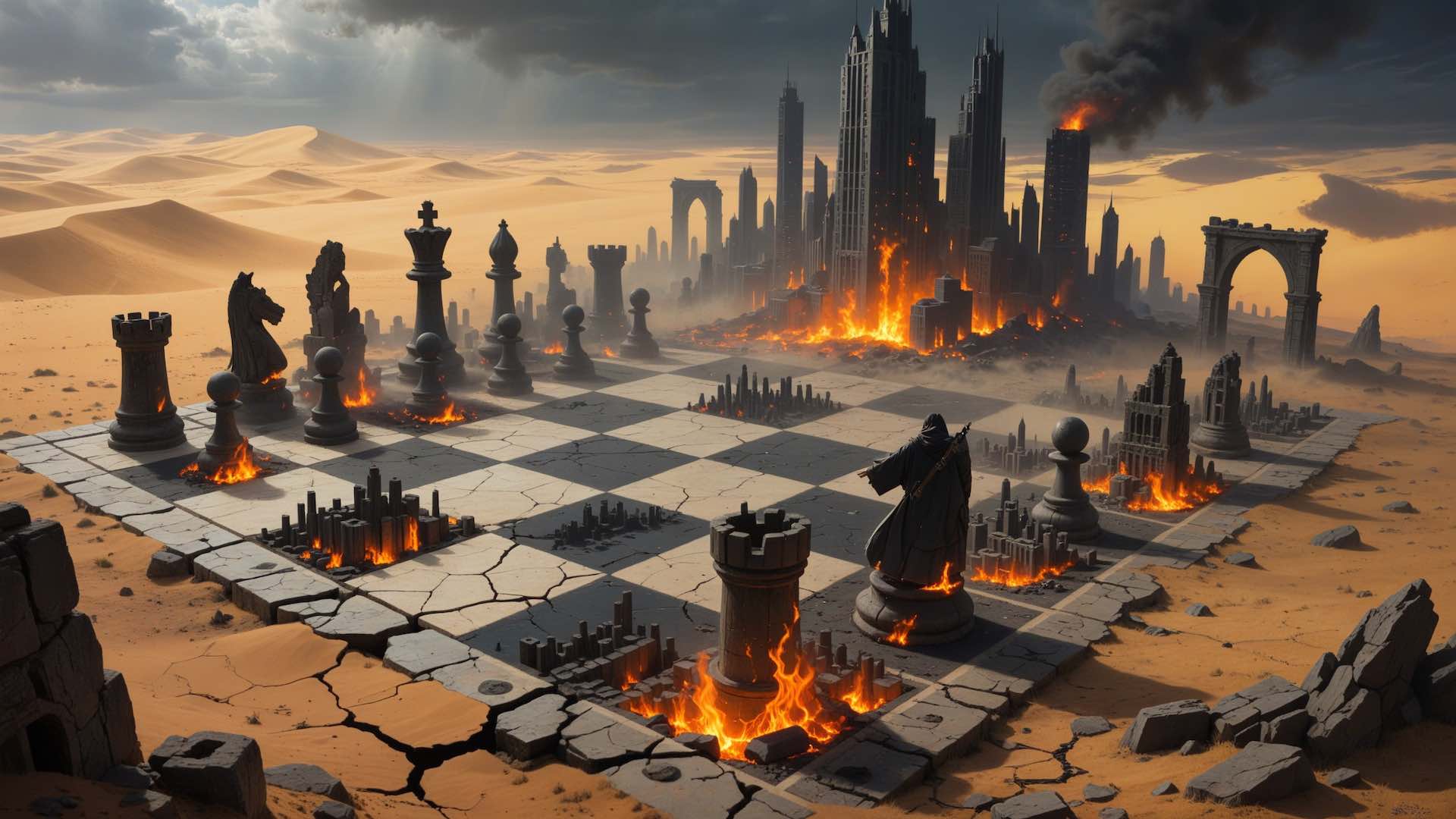
The moves on the chessboard certainly lead to disaster after disaster, yet we still let ourselves be convinced of victory in the next one - which is reminiscent of Crichton’s Gell-Mann Amnesia. The question to Bildt was “Whose side are you on?”. Another, and perhaps better, question is whether we shouldn’t step off the chessboard entirely.